
According to various meteorological reports from different countries, a raging typhoon in the West Pacific has apportioned a part of the southwesterly flow to itself, denying the Arabian Sea required moisture to flag off the monsoon in Kerala.

While the IMD had forecast a 'normal' monsoon for the entire season, Skymet stated that rain this year would be 'below normal', report Sanjeeb Mukherjee and Sahil Makkar.

'We are not saying we are going to face a drought... We are a doing and performing government. A contingency plan is being prepared,' Science Minister Dr Harsh Vardhan tells Rediff.com
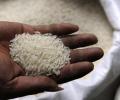
The government on Thursday imposed a 20 per cent export duty on non-Basmati rice except for parboiled rice to boost domestic supplies amid a fall in area under the paddy crop in the current Kharif season. According to a notification by the revenue department, an export duty of 20 per cent has been imposed on 'rice in husk (paddy or rough)' and 'husked (brown) rice'. The Central Board of Indirect Taxes & Customs further said the export of 'semi-milled or wholly-milled rice, whether or not polished or glazed(other than Parboiled rice and Basmati rice)' will also attract a customs duty of 20 per cent.
The contribution of agriculture, including allied sectors, towards the gross domestic product has been estimated at 20.53 per cent in 2004-05, Rajya Sabha was informed on Friday.

Though the summer is expected to be hotter, global and domestic forecasts point to good rains.

Till Thursday, the country had received 41 per cent less June rainfall than normal - the scantiest in a decade and one of the rarest occasions when the shortfall in the month was more than 30 per cent - private weather forecaster Skymet said in its daily weather forecast on Friday.

Temperatures remained above 45 degrees Celsius in large parts of Rajasthan, Haryana, Delhi, Chandigarh and Uttar Pradesh, affecting daily life as many chose to remain indoors in the afternoon.
India's agricultural production could see its biggest drop in more than two decades this year, due to a drought that hit nearly one-third of the country, Centre for Monitoring Indian Economy said on Friday.
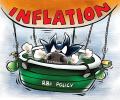
Reserve Bank on Wednesday said it expects retail inflation at 5.2 per cent in the first half of the current fiscal and revised downwards the target to 5 per cent for the quarter ended March. While headline inflation at 5 per cent in Feb 2021 remains within the tolerance band, some underline constituents are testing the upper tolerance level. Going forward, the food inflation trajectory will critically depend on the temporal and special progress of southwest monsoon in the 2021 season, RBI Governor Shaktikanta Das said on Wednesday while announcing the first monetary policy for the current fiscal. Reserve Bank of India (RBI) has kept the key repo rate unchanged at 4 per cent to support growth in the current situation.

The IMD has issued Yellow alert for Thiruvananthapuram, Kollam, Pathanamthitta, Alappuzha, Kottayam, Ernakulam, Idukki, Thrissur, Malappuram and Kozhikode districts for today whereas Wayanad too has Yellow alert on May 22.

A five-seven per cent agriculture growth in 2013-14 would mean farming might exceed the 12th Five-Year Plan annual growth target of four per cent, if the trend continues.
ICRA's GDP forecast is higher than the 6.0 per cent projection made by the Reserve Bank of India and Asian Development Bank for this fiscal.\n\n\n\n

After churning across the Arabian Sea for more than 10 days, Biparjoy made landfall near Jakhau Port in Gujarat on Thursday.

Nearly 21 per cent of the country has received "deficient" rainfall till July 31, the India Meteorological Department on Monday said.

Mumbai and certain adjoining areas experienced pre-monsoon showers, sources said on Sunday.
The Indian Meteorological Department announced that conditions are favourable for further advancement of monsoon to some parts of southwest Bay of Bengal

Experts say it will make GDP growth target of 5.7-5.8% difficult to achieve, while ministries feel late resurgence will help in sowing of rabi crops.
Skymet lowered its full season monsoon forecast to 'below normal' from 'normal', while the IMD is sticking to its earlier forecast that rains in June to September of 2018 would be 'normal' at 97 per cent of the LPA with a model error of +/-5 per cent.

ICICI Bank was the top gainer after stable rating for its senior unsecured bonds by S&P Global Ratings.

After imposing 20 per cent export duty on non-basmati rice, the government has banned the export of broken rice with an aim to increase domestic availability, according to a government notification.

The India meteorological department has stated that day temperatures are likely to be above normal by 0.5 degree Celsius, reports Sanjeeb Mukherjee.
Twelve out of the 15 warmest years since 1901 were during the past 15 years -- between 2006 and 2020, according to IMD data.

The country received 16 per cent more rainfall than its normal limit in June, the IMD on Tuesday said.

A three-judge bench headed by Justice BR Gavai sought a report from the Cauvery Water Management Authority on the amount of water released by Karnataka, after additional Solicitor General Aishwarya Bhati informed the court that a meeting of the authority is scheduled for Monday.
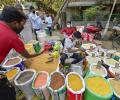
India's consumer price index (CPI)-based inflation could ease in the coming months thanks to the arrival of kharif crops, lower international commodity prices, and a pass through of lower input costs to consumers, the finance ministry said in its Monthly Economic Review (MER) for October, which was released on Thursday. The MER, however, warned that the global macroeconomic situation remained precarious and a recession in many advanced economies would impact India's exports. "Easing international commodity prices and new Kharif arrival are set to dampen inflationary pressures in the coming months.

A minister said the country had 7% less rain than normal.
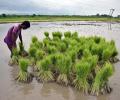
Trade and market players have already started factoring in at least 10 million tonnes drop in production in rice in the kharif season as compared to last year due to delayed sowing.
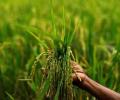
Riding high on the hopes of a normal monsoon, the agriculture ministry aims to increase foodgrain production by 6.35 million tonnes to a record 298.3 million tonnes in the 2020-21 crop year. The foodgrain output in the 2019-20 crop year (July-June) is estimated at an all-time high 291.95 million tonnes, as per the second advance estimates released by the ministry in February.
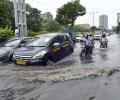
Some of the stretches and areas where waterlogging was seen included Dhaula Kuan, Mathura Road, Moti Bagh, Vikas Marg, Ring Road, Rohtak Road, Sangam Vihar, Kirari and near Pragati Maidan among others.

The RBI on Wednesday cautioned that while the Indian economy appears capable of weathering the deterioration in geopolitical conditions amid the ongoing Russia-Ukraine war, it faces headwinds from global spillovers from geopolitical tensions, elevated commodity prices and moderating external demand. The RBI, however, did not tinker with the GDP growth projection made in April. It had slashed the GDP growth projection for the fiscal 2022-23 to 7.2 per cent from its earlier forecast of 7.8 per cent.

'All El Ninos are not associated with the deficient monsoon.'

There should be one comprehensive and credible report on weather for India since a major part of the economy is dependent on it, says 'weather man' Angshujyoti Das.

Central Statistics Office has come out with GVA to measure growth.

Foodgrains production in 2020-21 is projected to be a record 144.52 million tonnes, which is 0.80 per cent more than the production in 2019-20.

Climate change has hampered the ability of the forecasting agencies to accurately predict severe events and weather bureaus across the world are focusing on augmenting the observational network density and the weather prediction modelling to improve predictability, India Meteorological Department (IMD) Director General Mrutyunjay Mohapatra has said.
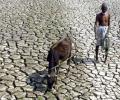
These three states sought a combined financial assistance of Rs 11,186 crore

Here's a look at the water-logging in the city.
